
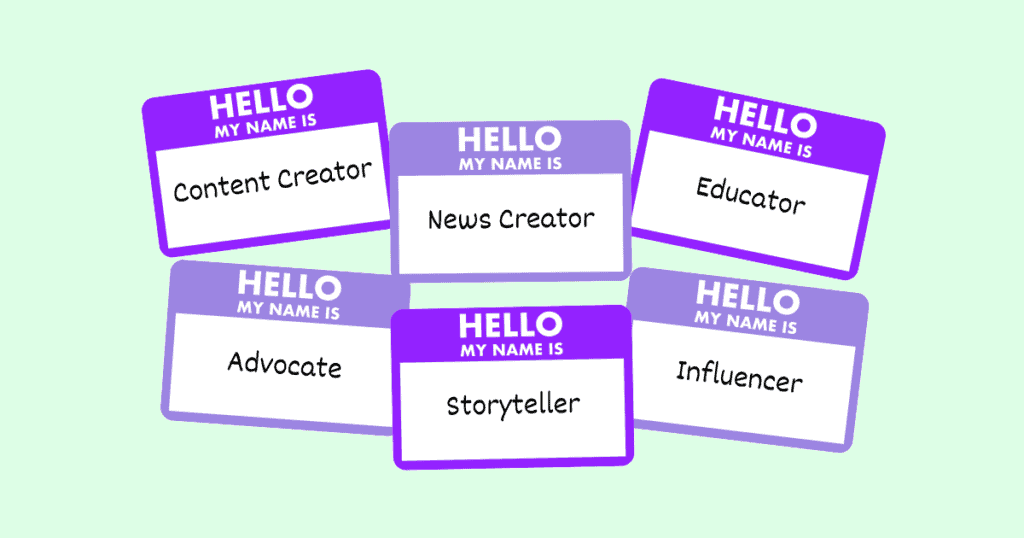
The term “content creator” is often used to describe people who post videos, pictures and more on social media. And yes, technically everyone who creates content online is a content creator. But the content spans from news to history to humor to ads, and lumping them all together under the same label does a disservice to people seeking specific kinds of content or information.
Several of News Creator Corps’ first cohort said it’s fine to be called a content creator – and it’s technically accurate – but they tend to see their work and jobs described more specifically, as an advocate, educator, storyteller, organizer and more. One throughline: Many of them preferred not to be called an “influencer.”
Using more specific terms that describe what they do helps their audience better connect with and trust them. And sometimes using the right term at the right time can open up an opportunity.
Danielle Desir Corbett, a travel writer, storyteller, and podcast host, said she thinks using the right terms to describe her title and work allows people to understand what she and her work are about quickly.
“I feel like specificity is important because it just offers you a taste of some of the things that I do without going too much into detail,” Corbett said. “Like when I say things like travel creator with a money lens, it kind of gets your wheels turning as to what type of content that I’m going to create at a very surface level. If I say things like I’m a podcast host, that’s very clear of what I do. So I think a balance of [generalization] and specificity is necessary because the word creator is so large.”
That’s also the reason she’s uncomfortable with the term influencing.
“It feels like a very superficial word that just to me sometimes feels like affiliate marketing,” she said. “For example, like, ‘Hey go do this thing, click on this link, buy this thing and that’s it, which is a part of what I do. So sure people are influenced to do certain things based off of the conversations that I bring to light, but it’s deeper than that.”
Becky Bullard, the founder and CEO of the creative civic engagement organization Democrasexy, said she primarily identifies as an organizer who uses social media as a tool to help people feel more confident to engage civically in Texas state and local Austin and Travis County politics.
“I think influencer makes me really uncomfortable because I’m not trying to sell anything,” Bullard said. “I like creator because we are creating content, but that’s not primarily how I think of myself. I believe that things can be better here in Texas, but it is going to require action from a lot of us. And so I see my role as gathering as many people as I can and empowering them in whatever ways I can to take that action.”
Kahja Elliott, a Bay Area transplant with a decade of experience exploring the region’s vibrant food scene, prefers the title “food enthusiast” because it avoids the negative connotation often associated with “influencer,” which Elliott feels implies superficial coverage, particularly in order to obtain free meals.
Ali Van Fleet, a meteorologist and climate communicator, dislikes the term “influencer” due to these same kinds of connotations, and said it diminishes the seriousness of her work. Van Fleet prefers titles that are more topic-related, such as “meteorologist,” “climate specialist,” or “climate communicator.”
Adriana Goblirsch said she would describe herself as a motherhood and postpartum advocate or curated news creator because she talks specifically about news impacting mothers and families.
“For sure I wouldn’t call myself a journalist,” Goblirsch said. “I wouldn’t even say I’m a news creator, but I do cover things that happen that might be impactful for mothers.” Just don’t call her a “mommy influencer.”
David Rushing described himself as a community leader. He helped build the NBA Threads community, driven by their long-time love for basketball and a desire for a more inclusive space after being discouraged by the culture on NBA Twitter.
Rushing said he was initially resistant to the term “creator” because it carried some stigmas, and he did not want people to think he was only engaging with them for personal benefits. Meta later started referring to him as a creator. Rushing said he’s more comfortable with the term now and acknowledges the paid opportunities that come with calling himself one.
“I do identify myself as a storyteller because that’s what I feel like,” said Jen Ruiz, an NCC alum who writes and creates social media content about travel. “I grew up in libraries. I’ve always enjoyed stories. And I think I always will be a storyteller regardless of the platform. I was a trial lawyer because I could tell the jury a story. I’m going to tell you the story of how this case went down, and by the time we’re done, my story is going to be a better story than the other guy’s story.”
But Ruiz said storyteller isn’t necessarily the professional title she uses first.
“I don’t think storyteller is well paid,” Ruiz said. “So I think, if I’m being honest, I will use the title based off of what I think is necessary for the professional opportunity that’s being presented. So if I am looking to get a book deal, I might call myself an author or a writer or an award-winning journalist. Anything that I feel is going to get the gravitas that it needs. If I am looking to partner with a brand and I know that they want to have social media content, then I’ll call myself a content creator, a travel influencer. It depends on what the opportunity is. If I’m applying maybe for a business grant or fellowship, I might refer to myself as an entrepreneur, a founder, chief executive officer. I am all those things as a one-person business and brand, so it really depends on the opportunity and how I want to frame myself to have the biggest chance of being understood for what it is that I am applying for.”
Zachory Kirk calls himself an educator.
“We’re all creating content, right?” Kirk said. “When you send a tweet, you’ve created content. And there’s nothing wrong with that term. It’s just that to me, it’s too broad.”
Influencer isn’t quite right either, Kirk said.
“My goal is to educate,” he said. “You can do what you want to do based on it. I feel like influencers have a specific job to influence you to do X, Y, or Z. I don’t care who you vote for. I just want to make sure that you’re educated and that you are informed about what is happening so that you are able to make a decision that’s based on accurate facts and data and information before you cast that vote.”
But Kirk said he doesn’t really care about being called the wrong term.
“That’s just me,” he said. “I am a rare person in this space. I do not care about likes, clicks, and views. And I really don’t care about people’s perceptions who do not actually know the content. The people who follow me and who consume my content will never be in any way misled about who I am and what I do.”