
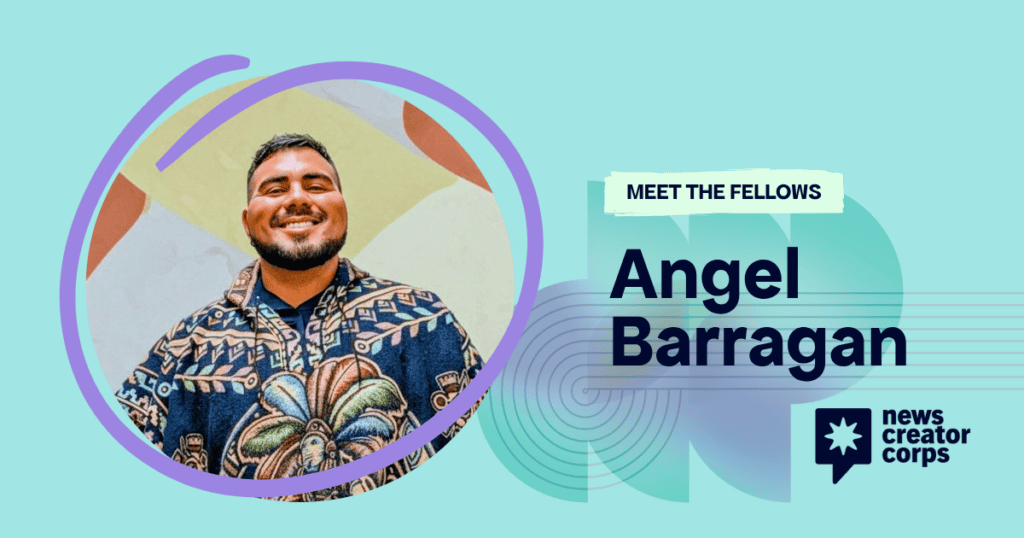
When Angel Barragan went from being a teacher to a principal, he freaked out. As a former ethnic studies and human rights teacher, one part of education that he loved was the opportunity to enlighten people in ways that empowered them.
That’s when he turned to social media.
“It led me to, ‘Well if I’m not going to be educating in the classroom, if I’m going to become an administrator for schools, I’ve got to find another way to be able to do that,’” Barragan said.
He also quickly realized that, at the time, there was a gap in representation for his community on social media. He came across TikTokers who made fun of the immigrant experience, but it was difficult to find people uplifting immigrants.
“I felt like there was a gap for somebody that was educated, well spoken – an advocate for the community that wasn’t gonna sell out, that wasn’t going to put the community on the back burner for a few laughs,” Barragan said.
Barragan, a DACA recipient who came to the U.S. when he was 10 years old, said he’s had the privilege of an advanced degree that is often difficult for people who come from backgrounds like his. He wants to use his education to educate and advocate for immigrants. And he also wants to make them feel seen through his presence on social media.
“I was a principal,” he said. “I have a master’s degree. That’s crazy for somebody who’s 33 and who also came from a very poor immigrant background.”
Now, Barragan does content creation full time with a clear mission in mind.
“I’m an immigrant and an advocate for immigrant rights,” he said. “My mission in life and my mission with the work that I do is the uplifting and liberation of all historical marginalized communities with a hyperfocus on people labeled immigrants with indigenous ancestry to this continent.”
Uplifting marginalized voices can be done in many ways, including supporting a movement or bringing awareness when someone is creating harm to the community. For example, Barragan said he will pull out a video of somebody doing something racist, react to it and follow up with educational commentary.
“I think me simplifying the communication is one way to help educate and uplift and also show folks that people can be held accountable and that people have the power to be able to respond to harm,” Barragan said.
He said he also builds connections and trust with his audience by being as transparent and genuine as he can, sharing his own insecurities and experiences, like his dad’s deportation.
As a young person, Barragan said he often had to deal with difficult situations, but the skills he learned from that trauma help him as a creator navigating the topic of immigration online.
“In the social media world, oftentimes I end up finding stories that are very traumatic, that are very heavy, that carry an emotion,” he said. “Or maybe I’m doing my live streaming and I’m talking to somebody that has an opposite belief, and they’re telling me that I should be deported. And I’m just able to maintain this calm that allows me to hyperfocus on what my values are and what my goal is.”
Barragan hoped the News Creator Corps fellowship would help him on his journey to find self-sustainability for his work online, since he left his job as a principal. He partnered with The Trace to bring new information to his platform about the use of guns in immigration enforcement.
“I think misinformation carries such a heavy weight right now and it’s creating actual harm,” Barragan said. “Portraying accurate information is a way to fight for our community, to uplift our community, to be able to keep our community educated, and to make sure that it doesn’t get lost when it comes to fighting for the things that matter. A lot of content creators are focused on growing and not in protecting the community. And if they are not responsible with the content that they’re creating, they are actually doing harm.”